Pages

Saturday, May 29, 2010

The Floating Village on Tonle Sap Lake

Posted by Picasa

The Floating Village

Absolutely unbelievable!  My mind cannot rest because it is still swirling from blocks of color and reflecting light!  Last night, some of the guys from Sustainable Cambodia (SC) took us 'barangs' (the Khmer word for 'foreigners') out to the Floating Village that is located on Tonle Sap Lake.  When we first approached the entrance I was a bit worried because the poverty conditions were so harsh.  Thatched dwellings that looked like they were about to fall over were baking in the sun-- no trees or vegetation to seek refuge from the searing heat.  Trash was strewn everywhere and a few naked children were running about; the people were very poor.  An animated woman wearing a Chinese- style peasant hat was talking  with our SC guides and they were apparently working out some kind of arrangement.  Finally, we were led to some long, wooden boats that were on the shore.  I was surprised and relieved that we were going for a boat ride, away from the poverty and filth.
 
The boat driver started the motor and away we went into the direction of the great lake, the Tonle Sap!  The water appeared thick and greenish- brown, the result of algae and suspended sediment.
 
We crossed the lake and approached what appeared to be another village: a floating village!  As we got near, bright colors jumped out from every direction.  Maybe it was the brown water and the gray and weathered wood of the dwellings that illuminated the bright palette of flowers, clothing, fabric, plastic buckets, signage, and steel barrels. And it was amazing that the boats and floating houses were painted in bright decorative designs.  It was a scenery that displayed an appreciation for vibrancy and life!

The boat docked at a restaurant-- yes, it too, was floating--  and we all climbed on deck as we were greeted by a scrappy, but cute dog.  Chenda, our SC guide and gracious host, took charge and ordered drinks and food for the table and soon we were enjoying cold sodas and beer, sun- dried fish and shrimp, steamed clams, and noodle dishes with beef and egg.  Life was good!

Friday, May 28, 2010

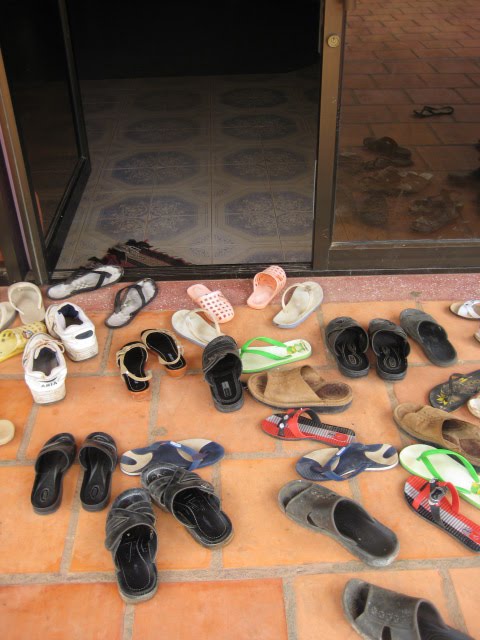
Shoes, shoes, shoes....

Posted by Picasa

Cool fans and street shoes...

There are two things I really enjoy about Cambodia. First, it is common to take a two hour siesta, from noon until 2pm each day-- the hottest part of the day.  This I can really appreciate as the buildings in Pursat have little or no air conditioning.  The oppressive heat and humidity makes it absolutely necessary to have lunch, take a cool shower, and then a short nap in front of a high speed fan. The second thing is that the people here take off their shoes before entering a building or someone's house.  To do otherwise is disrespectful...  so, to all my good friends out there whom I insisted take off your shoes before entering my home:   "Finally, I have found others like me!"

Today I helped the librarian set up a database for checking out books. The library has several hundred books that are not cataloged and there are no check-out records. I found a trial version of a library checkout software that seemed to be a good tool...  the catch, however, is that after cataloging 100 books, the trial version ends and a purchase is required.  With little or no budget to purchase software, the library finds making improvements a bit difficult.  I suggested we enter the books into the database and use it for a week or two to see how useful it is, and then....  a $49 purchase price?  Not too shabby really... perhaps I can muster up a donation... but first, I'll check to see if there are any open source or free programs out there...

Thursday, May 27, 2010

NEW: Villages of Veal and Prek- Py

I woke about 5:00 am in order to get ready for a journey to Veal and Prek- Py, two villages approximately 20- 30 km outside of Pursat.  It was going to be a big day because each village had a ceremony scheduled where the villagers would be instructed on how to use their bio- sand filters before being issued a water container.  For many years previous, villagers would get their drinking water out of the rivers during the dry season. But because of rapid growth of the towns nearby, the rivers can no longer be relied upon for clean drinking water. The bio- sand drinking filters are now important to these communities because they will remove harmful bacteria and viruses from the water.  During the rainy season, each dwelling is equipped with rainwater collection where water is collected from the roof into large vase- type cisterns. The bio- sand filter plays an important role here too, as it can remove debris and contaminants.  But education is essential because learning new ways of doing things often takes time, especially when there is maintenance and upkeep involved.

The road out to the villages began as a paved road and then quickly turned into compacted red dirt.  Actually, the dirt roads weren't in too bad of shape and everything from motos, to bicycles, pedestrians, cows, dogs, and chickens were sharing the road with few cars and trucks. Whatever moves the fastest has the right-of-way, the only exception being cows and livestock-- all yield to these slowest moving travelers.

The journey was a lively experience, especially since Khmer music was playing in the car.  I really like Khmer music and can't wait to bring some home with me...  a romantic music of voice and violin-- reality seems to sway and dance and life is magical....

The farther one travels into the countryside, the more beautiful it gets!  Mountains are off in the distance, there are rivers, and the scenery is lush.  There are dwellings on stilts, rich pastures and rice fields-- it is a way of life I have only read about or imagined:  simple, quiet, and beautiful.

NEW: Villages of Veal and Prek- Py

I woke about 5:00 am in order to get ready for a journey to Veal and Prek- Py, two villages approximately 20- 30 km outside of Pursat.  It was going to be a big day because each village had a ceremony scheduled where the villagers would be instructed on how to use their bio- sand filters before being issued a water container.  For many years previous, villagers would get their drinking water out of the rivers during the dry season. But because of rapid growth of the towns nearby, the rivers can no longer be relied upon for clean drinking water. The bio- sand drinking filters are now important to these communities because they will remove harmful bacteria and viruses from the water.  During the rainy season, each dwelling is equipped with rainwater collection where water is collected from the roof into large vase- type cisterns. The bio- sand filter plays an important role here too, as it can remove debris and contaminants.  But education is essential because learning new ways of doing things often takes time, especially when there is maintenance and upkeep involved.

The road out to the villages began as a paved road and then quickly turned into compacted red dirt.  Actually, the dirt roads weren't in too bad of shape and everything from motos, to bicycles, pedestrians, cows, dogs, and chickens were sharing the road with few cars and trucks. Whatever moves the fastest has the right-of-way, the only exception being cows and livestock-- all yield to these slowest moving travelers.

The journey was a lively experience, especially since Khmer music was playing in the car.  I really like Khmer music and can't wait to bring some home with me...  a romantic music of voice and violin-- reality seems to sway and dance and life is magical....

The farther one travels into the countryside, the more beautiful it gets!  Mountains are off in the distance, there are rivers, and the scenery is lush.  There are dwellings on stilts, rich pastures and rice fields-- it is a way of life I have only read about or imagined:  simple, quiet, and beautiful.

NEW: My first day in Pursat...

Time for catch- up! 

I arrived at Sustainable Cambodia in Pursat on Saturday, May 22, 2010.  Immediately upon my arrival, I was greeted by the other volunteers, Kevin, Paulina, and Anisha.  They showed me to my room, which is pretty nice-- spacious and clean with a couple double beds, a desk, compact refrigerator, TV (not necessary!), and a large bath.  I dropped my off my bags and then went to lunch at a restaurant down the street.
Polin informed me that there was going to be an art drawing competition at 3:00 pm in the library and perhaps I should check it out.  Thus began an afternoon of meeting the school children and teachers and it is no exaggeration that every time I turned around there was another student wanting to meet me!  "Hello, how are you?"  "What is your name?"  Because learning English is so important in Cambodia, the children were very excited to have a new volunteer with whom they could practice their English.  I had so many interesting and refreshing conversations-- one student wanted to talk about Barak Obama, the United States government, politics, and world history.  Several other girls wanted to talk about their hopes, dreams and their experiences about being young women in Cambodia.  In Cambodia, family traditions are strong and the girls openly expressed their frustration of being torn between continuing their education or honoring their obligations toward family.  The cultural pressures for a young woman to stay at home and assist her struggling family and of finding a husband before she gets too old are great.  Some of these girls want a quality education and the opportunity to study at a university or study abroad, but are unsure of how to access the resources that would help them to do so.  They were curious about my history and how I managed to find my own independence.  My response to this sensitive topic was to talk about the importance of finding balance in one's life, to continue learning for the benefit of one's self, while also giving attention to family and community. I could sense that the word "balance" and the idea of it was a bit new, but then I am always astounded at the idea when I think of it for myself......  

In the mid- 1970's the Khmer Rouge wiped out education and schools in Cambodia by murdering  teachers and the educated elites.  The country is still in the long process of rebuilding its education system; the parents and grandparents of the current generation suffered greatly during the Khmer Rouge, but with each day, there is progress....

In Cambodia, opportunities for advancement are few, especially for the poor, but things can change rapidly in our contemporary economic climate-- it is possible that opportunities will open up to more young people in the future.....   it seems there are many people and organizations that have good intentions, and are working towards building more resilient communities.....
 
After several hours of greetings and conversation, I was a bit wiped out!  But I can hardly express in words the impression these interactions had on me; the young people of Pursat have such an appreciation for their education and they have a strong desire to want to do more for themselves and their community...